
Copyright
All posts related to this category.


EU Parliament seeks a balance for rightsholders
CEPIC has welcomed the European Parliament’s report on copyright and generative AI, which calls for urgent legislation to address imbalances between AI companies and rightsholders. The report emphasises transparency, fair remuneration, and stronger control for creators over how their work is used in AI training and beyond.

Protecting copyrighted work and the EU’s creative sector in the age of AI
On 10 March 2026, the European Parliament adopted a resolution on copyright and generative AI, stemming from the report “Copyright and Generative Artificial Intelligence: Opportunities and Challenges”. The resolution was adopted with 460 votes in favour, 71 against and 88 abstentions. MEPs stated that EU copyright law should apply to all generative AI systems placed on the EU market, regardless of where they were trained. The Parliament is calling for transparency regarding the use of copyrighted works to train AI, fair remuneration for rightsholders, and measures to protect the cultural and media sectors, including the press.
Content Superpower: UK publishing and the AI licensing market
The report provides important evidence against any form of copyright exception and in favour of transparency requirements on AI developers ahead of the government’s update on AI and copyright, due by 18 March.
CEPIC Webinar Recap: AI and Copyright The Kneschke v LAION Appeal
CEPIC recently hosted a legal webinar with photographer Robert Kneschke and his legal representative Sebastian Deubelli, bringing together 40 participants from around the world to discuss the ongoing Kneschke v LAION appeal. Held under the Chatham House Rule, the session enabled open, in-depth discussion on the global implications of this landmark AI and copyright case, with CEPIC reaffirming its support for Robert Kneschke’s efforts to achieve legal clarity for creators.

CEPIC on Ensuring Fairness and Legal Consistency in AI and Copyright Policy
CEPIC) has published its recommendations on the Draft Report on Copyright and Generative Artificial Intelligence – Opportunities and Challenges, calling for a fair, transparent, and legally consistent framework that protects Europe’s creative industries.
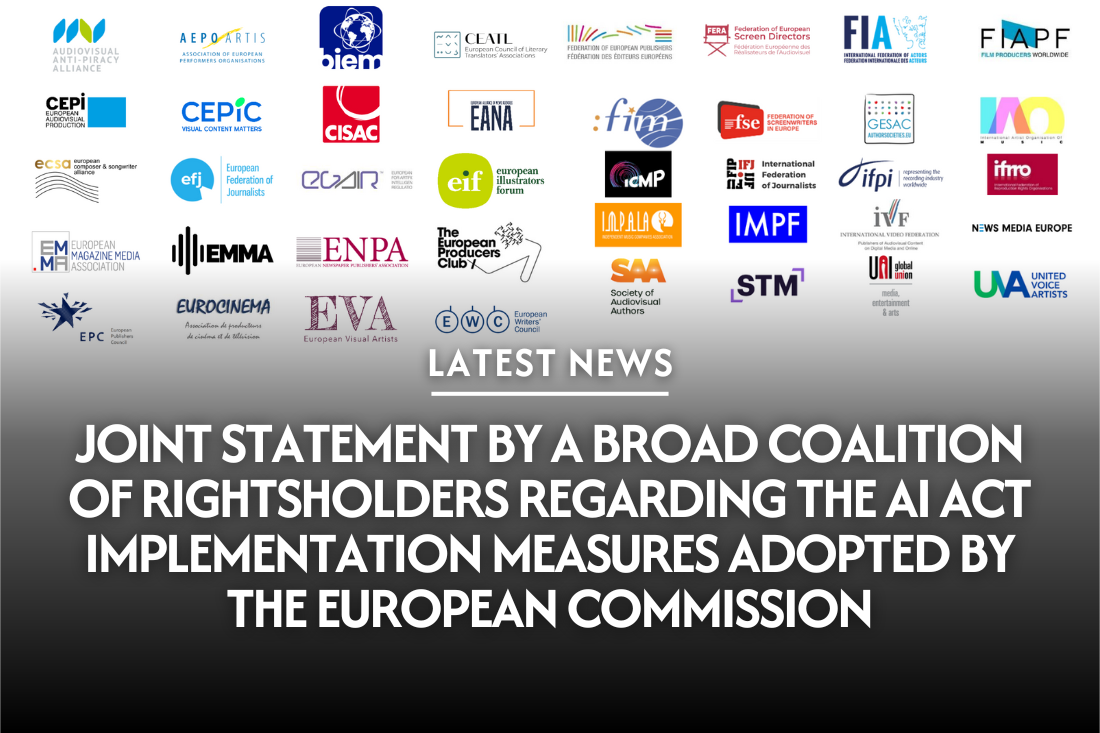
Joint statement by a broad coalition of rightsholders regarding the AI Act implementation measures adopted by the European Commission
A broad coalition of rightsholders from the cultural and creative sectors in the EU has expressed dissatisfaction with the European Commission's implementation measures of the AI Act, particularly the GPAI Code of Practice and Guidelines. They argue that the measures fail to address key concerns about the protection of intellectual property rights and do not fulfil the promises of the AI Act, which was intended to safeguard European copyright holders in the age of generative AI.

Combating Online Misinformation: Launch of "Provenance for Trust"
Provenance for Trust," a new initiative from TrustMyContent, UncovAI, and the Journalism Trust Initiative, aims to restore trust in media by ensuring content authenticity and traceability. The program addresses key issues like AI transparency and copyright protection, providing solutions to combat misinformation.

Genshagen Theses published
Experts and cultural figures from Poland, France and Germany have presented proposals for a human-centred approach to generative AI as part of the Polish Presidency of the Council of the European Union.

CEPIC 2026
Building on the success of previous years, CEPIC 2026 promises to be our most exciting event yet. Three days of business, connection, and inspiration in the vibrant city of Valencia, Spain. This unmissable gathering brings together visual media professionals to explore new opportunities, share ideas, and shape the future of the image licensing industry.