
The International Authors Forum (IAF) and IFRRO held a week-long joint event in Mexico City during the last week of March. On the first day, IAF held their AGM where I’m delighted to say that PICSEL was elected with nine others as a new member. These new members illustrate the global nature of collective rights management with representatives from Chile, Colombia, South Africa, Saudi Arabia, Trinidad & Tobago, Moldova, Kazakhstan, Tanzania and Spain joining PICSEL from the UK.
The global nature means that a lot of IAF’s work is done in conjunction with WIPO and IFRRO. It was heartening to hear the Secretary General, Kevin Fitzgerald, say that the IAF will be a significant voice at WIPO in the coming years for the visual arts, principally in extending ARR as well as promoting licensing for AI use.
Anita Huss-Ekerhult, CEO and Secretary General of IFRRO, spoke about the many years of collaboration with the IAF, and of the increasing relevance of visual images in the work of IFRRO. This was manifested in their ongoing consultation with WIPO for creators and their joint study with CISAC on text and images launched during the week.
The second day saw the joint IAF and IFRRO meeting opened by Maestro Alberto Arenas from the National Copyright Institute in Mexico, INDAUTOR, who outlined current Mexican legislation on copyright. “AI is rewriting the rules, and never has it been more difficult to get fair remuneration” he began, before adding that there should be “a harmonious relationship between culture and technology.”
In the UK we hear little about the effect on translators from AI. Here the representative from one of our hosts, AMETLI representing translators, told us that assignments and income of translators has been hit hard with translators losing 25-30% of work in the last two years. The result is less diversity and increased bias “when we should be defending the quality of our culture by demanding ethical and unbiased AI.”
Many speakers said that copyright was at risk and we were reminded not to forget the genesis of these AI products.
There is the same rage, and clear thinking, in Latin America as there is in the rest of the world. Equally, there are billions of dollars on offer for data banks if laws are changed, which is difficult here when copyright is enshrined in several Latin American constitutions which cannot be changed.
Anita Huss-Ekerhult announced the publication of the Private Copy Global Survey 2026 with key points being that there are minimal costs to consumers and there is stable revenue over time. All of us involved in The Smart Fund ask if the UK is really any different whilst we try to bring about a private copy levy for UK creators.
It was a great pleasure to be an observer at the IFRRO Latin America and Caribbean group (LAC) meeting which took up the final days of the week. The condition on me attending was that I gave a presentation on licensing images in the UK.
I realised that I am as guilty as every member of any trade association or member organisation in not appreciating what is done on our behalf behind the scenes, the everyday work of the secretariats.
I constantly read in IFRRO posts that Anita Huss- Ekerhult, the Secretary General and CEO of IFRRO, is in Baku one moment, Botswana the next, then Paraguay. I was intrigued. I wanted to see the daily work of the secretariat which had to be far removed from the two annual conferences. It is impressive.
It’s clearly focused on helping emerging organisations with advice and guidance, with the support of WIPO who provide free software that standardises industry practice. Importantly they are pro-active. More than once, I would hear Anita ask, “How can we help?” I was impressed by the secretariat anyway but am astounded now by the amount of work they do internationally in liaising with Governments on behalf of members.
We have it a lot better in the UK, but this group has so much fighting spirit, support from each other and IFRRO that they will thrive. It should be noted that CEDRO in Spain is giving them enormous support and guidance. They also have in Brazil what Anita called the best AI legislation anywhere in the world.
However, there is nothing different in what LAC members are experiencing with Tech, nor are their own requirements different to ours. Sadly, many of their governments are in the same inertia as ours with tech offering billions in promised investment. What is different is that they are working together and supporting each other continentally.
All trade associations work on behalf of their members for their benefit, but that is very easy to forget in the maelstrom of our daily business. It helps though if you can have the insight that I was fortunate to be given to see what is done on a different continent and how much we share.
Muchisimas gracias.
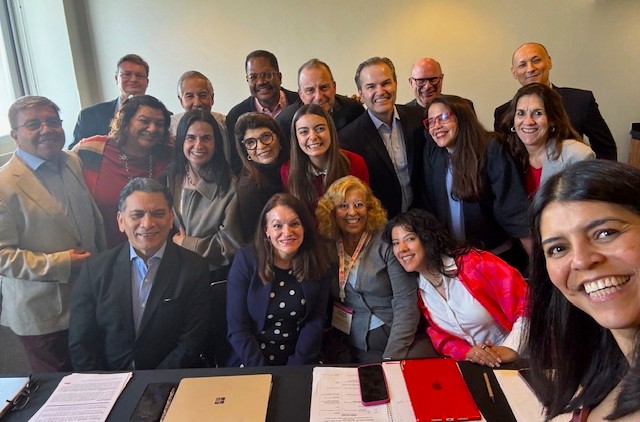
With thanks to Paul Seheult (PICSEL / BAPLA) for sharing his insights with the CEPIC community.