
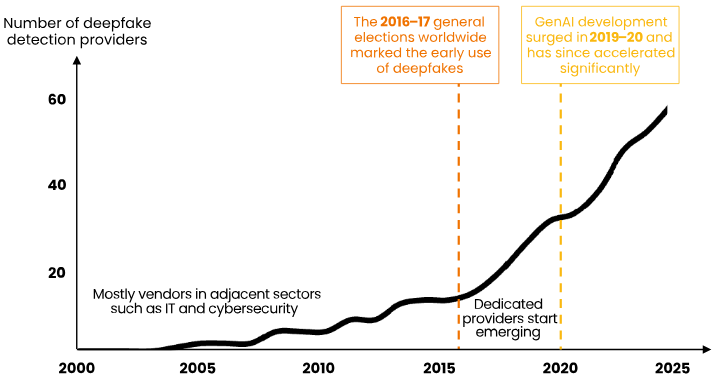
A recent UK government report highlights the rapid growth of deepfake detection technologies, but also makes it clear that the market is still in its early stages. While adoption is increasing across sectors such as finance, media, and law enforcement, detection tools remain inconsistent, with accuracy often dropping significantly in real-world scenarios compared to controlled testing environments.
The challenge lies in the pace of innovation. As generative AI makes deepfake creation cheaper, faster, and more realistic, detection technologies are struggling to keep up, creating what the report describes as an ongoing “arms race” between creators and detectors. At the same time, a lack of standardised testing frameworks, limited high-quality training data, and low public trust in detection tools are slowing adoption and investment.
Importantly, the report emphasises that detection alone is not enough. Governments are increasingly looking at regulatory solutions, including clearer legal frameworks and potential criminalisation of harmful uses, such as non-consensual deepfake imagery, as well as restrictions on tools designed for abuse.
Looking ahead, the future of deepfake detection will depend on stronger regulation, improved datasets, and standardised evaluation methods. Without these, even the most advanced detection tools risk falling behind an ever-evolving threat landscape.
👉 You can read the full UK government report here: Deepfake Detection Technology – GOV.UK